

For this year’s contemporary art fair ArtVilnius’26 (October 2-4, Litexpo), GODÒ gallery plans to present two independent yet contextually connected exhibitions across two booths: a joint zoomorphic-themed presentation by artists Giedrius Jonaitis, Džina Jasiūnienė, and Martin Gredler (Austria), alongside artist Andrius Makarevičius’ solo project “Portalas 2.0“.
Meet as at Stand 5.21
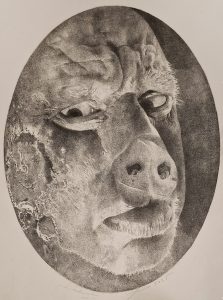
Giedrius Jonaitis explores the zoomorphic theme through his broad artistic arsenal. Often referred to as a master of lithography, the artist combines surreal compositions with a meticulous realist manner. In this exhibition, he presents his latest lithographs, in which the boundaries between human and animal forms dissolve into a kind of phantasmagoria. With a characteristic sense of humour, he continues this doubling of two forms in his latest series of reworked litas banknotes. Here, historical figures depicted on the banknotes are transformed into beasts – an artistic gesture for which the author has a particular moral claim, having himself designed Lithuanian litas banknotes between 1991 and 2007. These works embody Jonaitis’ self-irony (after all, some of the redesigned banknotes were his own creations) and his ability to combine meticulous draftsmanship with expression and coincidence. The latter, energetic and spontaneous drawing manner is also evident in his drawings. Alongside these works, taxidermy-based objects appear and reveal artist’s characteristic humour, inventiveness, and tendency to combine seemingly incompatible elements. The booth will feature an iron wolf – a symbol of Vilnius – reimagined as a hybrid creature, part historical, part futuristic, and other armoured beasts with laser-like gazes or smoke coming out of the nose.
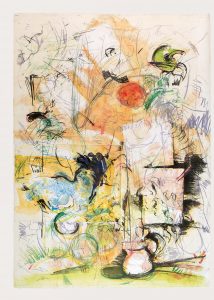
Guest artist Martin Gredler from Salzburg, founder of the printmaking studio Grafische Werkstatt im Traklhaus, will present a contemporary approach to lithography. Rather than using lithography solely as a reproductive technique, the artist employs it as a distinctive expressive medium, creating unique prints by using multiple stones instead of a single one. Several layers – in some works up to 50 – overlap the original drawings, forming depth and space within the print. The printing press here no longer functions as a reproductive device but becomes a mechanical brush. Interestingly, the presented series also introduces an indirect motif of taxidermy through imagery connected to the artist’s long-term fascination with private and museum taxidermy collections, exploring the boundary between the “living” and the “dead,” scientific precision, and unsettling content.
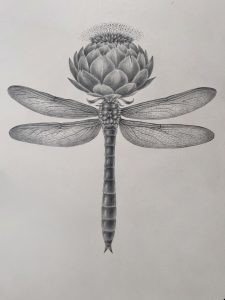
Džina Jasiūnienė draws inspiration for her lithographic series from the 1860 natural encyclopedia Life of Animals by Alfred Edmund Brehm, illustrated by the renowned German graphic artist Gustav Mutzel (1839–1893). His works are distinguished by exceptional precision, anatomical accuracy, and remain among the finest examples of classical naturalistic illustration. In her lithographs, Jasiūnienė seeks to recreate this distinctive mode of depicting nature, combining scientific accuracy, decorative qualities, and elements of imagination that expand our perception of the natural world.
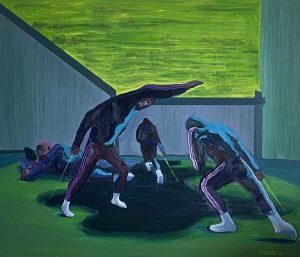
In the neighbouring booth, the gallery will present the latest paintings from Andrius Makarevičius’ series “Portalas 2.0“. The Portal – one of the symbols of the station district and a well-known installation connecting Vilnius and Lublin via live broadcast – is expanded in the artist’s work into a metaphysical concept. It becomes a threshold linking the Vilnius station district with the beyond, the present with the shadows of the past, and factual reality with intuition. Makarevičius’ newest paintings retain his recognisable expressive brushwork and the phantasmagoric narratives of station district inhabitants – both humans and pigeons wearing three stripes – while further intensifying the surreal tension between space (or emptiness) and reality (or illusion). This effect is amplified by an increasingly vivid, almost neon colour palette that disorients the viewer, raising the question: is this artificial, synthetic reality constructed by Makarevičius himself, or generated by the Portal?
Together, the two gallery exhibitions form two poles – the animal and the human. Yet neither the animals created by Jonaitis, Gredler, and Jasiūnienė nor the figures in Makarevičius’ paintings are direct reflections of reality; they exist in a balance between recognizability and imagination. On one side, animals take on mythical or fantastical traits; on the other, humans become strange, almost surreal actors within the urban landscape. In this way, the exhibitions presented by “GODÒ gallery” converge in a shared liminal tension between reality and fiction.
For more information: https://artvilnius.com/