
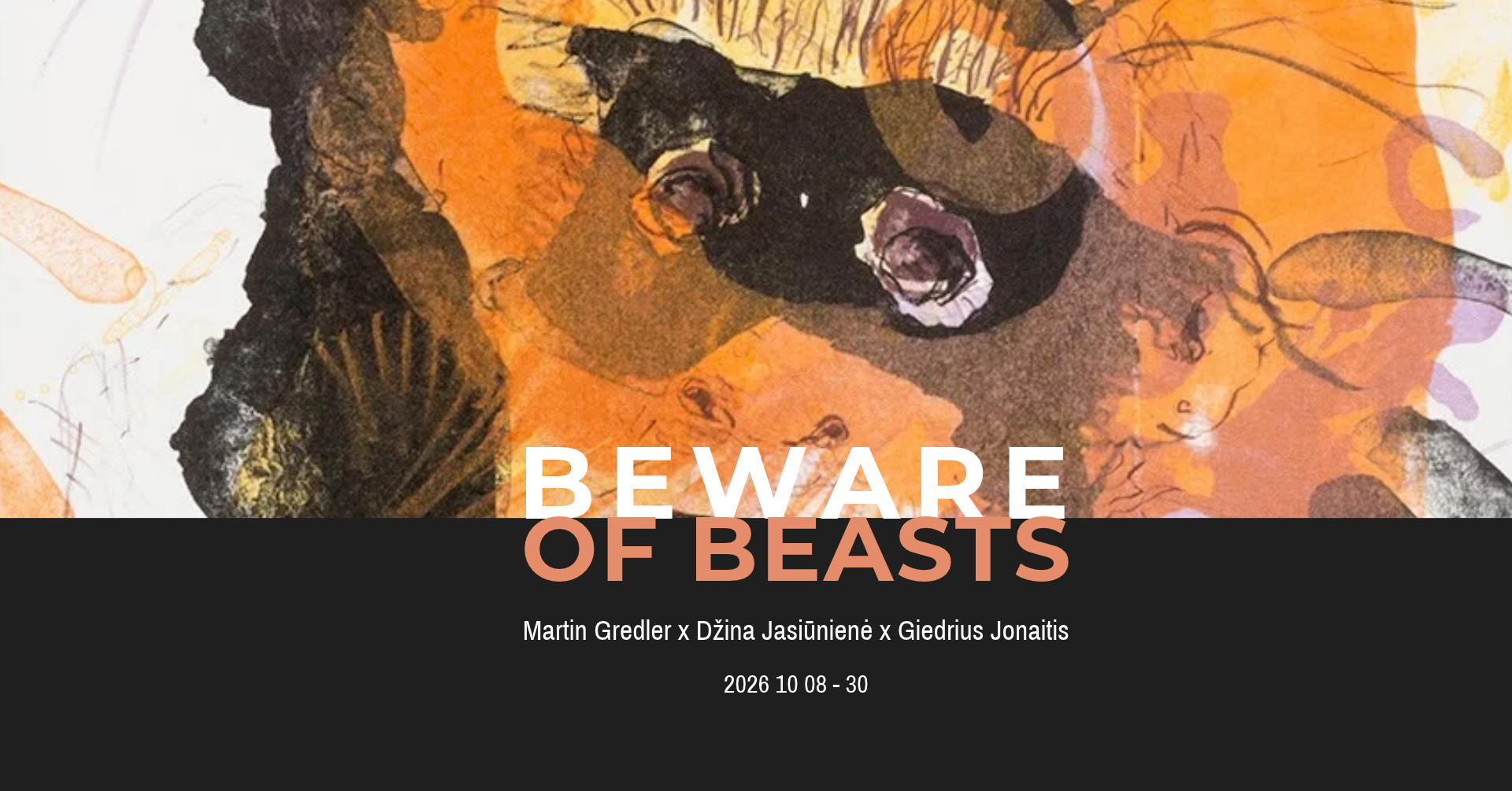
October 8–30, the Vilnius art space GODÒ gallery presents a group exhibition “Beware of Beasts” by Martin Gredler (Austria), Džina Jasiūnienė, and Giedrius Jonaitis. The exhibition brings together three distinct artistic languages through a shared zoomorphic theme, with lithography at its core – a labour-intensive manual flat-printing process dating back over 200 years.
Opening: October 8, 7 PM.
Moving between delicate, traditional stone drawings, realistic phantasmagoria, and powerful, experimental printmaking gestures, the exhibition presents a humorous and affectionate exploration of becoming and passing away, of transformation and enchantment, of intention and chance, conjuring up an ambiguous reality.
Salzburg-based artist Martin Gredler, director of the city’s Grafische Werkstatt im Traklhaus, uses lithography not as a means of reproduction, but rather as an independent artistic medium, one closely related to painting and collage.
Through a complex and refined process, Gredler creates unique prints in which the image emerges from numerous lithographic stones and layers of printing. In some works, there are as many as fifty. The initial drawings gradually disappear beneath new layers, creating a sense of depth and space, while the printing press becomes a kind of mechanical brush.
In Gredler’s work, the zoomorphic theme emerges through the motif of taxidermy specimens. His longstanding interest in private and museum collections of taxidermied animals – preserved for scientific purposes or as trophies – becomes one of the main motifs of his lithographs. These specimens occupy a space between the “living” and the “dead”, scientific precision and unease. Gredler carries this tension into the very structure of the image: using a free, expressive line, he records museum specimens, combining them with abstract motifs, spontaneous strokes and isolated images, sometimes incorporating a child’s drawing or a mechanical diagram. Familiar objects begin to enter new and difficult-to-explain relationships, sometimes receding into the background, sometimes unexpectedly becoming the narrative focus. In this way, Gredler layers his images not only technically but also in terms of meaning. Documentation of taxidermied specimens serves as an impulse for opening up a dense stream of imagery – although at times the strange narratives of his works begin in reality itself. Who would believe, for instance, that a monkey discovered in a museum archive was actually holding a beetroot someone had placed in its hands?
Džina Jasiūnienė’s lithographs draw on the tradition of nineteenth-century natural history illustration, with her specific source being the encyclopaedia Life of Animals by Alfred Edmund Brehm. The illustrations created for the encyclopaedia by German artist and printmaker Gustav Mutzel (1839–1893) are distinguished by their exceptional precision, anatomical accuracy, and decorative quality, and remain among the most striking examples of classical natural history illustration. Jasiūnienė adopts this aesthetic of depicting nature, but transforms it: scientific precision merges with elements of fantasy, while the clear boundary between fauna and flora gradually disappears. Animals and plants become a single organism: a dragonfly may acquire an artichoke head, while a seahorse may grow dragonfly wings.
The artist retains the observational and documentary manner characteristic of encyclopaedic illustration, making even the most unexpected combinations appear meticulously studied. Precise drawing creates a strange sense of recognition – although it is obvious that such an animal does not exist in nature, for a moment it appears entirely plausible. It is precisely this combination of the precisely depicted and the impossible that makes Jasiūnienė’s works so compelling: fantastical creatures are presented with such calmness and accuracy that, for a moment, their existence seems entirely natural.
Giedrius Jonaitis, often referred to as a master of lithography, combines surreal compositions with a meticulous realist manner. In this exhibition, he presents lithographs in which the boundary between human and animal forms dissolves into phantasmagoria. With his characteristic sense of humour, he continues this doubling of human and animal forms through drawing, a medium he has become particularly fond of in recent years. In his latest series of reworked Lithuanian litas banknotes, historical figures depicted on the notes are transformed into beasts – an artistic gesture for which Jonaitis has a particular claim, having designed Lithuanian litas banknotes himself between 1991 and 2007. He had previously transformed the figures of Darius and Girėnas on the 10-litas note into cats; this time, the transformation encompasses the entire iconography of the banknotes. Familiar faces from history, altered in form, retain their former character and even their features, while becoming peculiar characters from an alternative history. They embody Jonaitis’ self-irony and his ability to combine the mastery of detailed drawing with expression and chance.
Although Jonaitis, Jasiūnienė, and Gredler work in different ways, in their works the animal constantly slips out of its familiar form – becoming a character from the imagination, a strange witness in a museum, or a creature endowed with human traits. The encounter of these different artistic approaches and aesthetics within a single space creates a peculiar atmosphere, while animal motifs, travelling from one work to another, begin to form a mysterious and layered story.
During the exhibition, Martin Gredler’s book “A Lithuanian Story” will also be presented. The publication traces the artist’s longstanding relationship with Vilnius and its vibrant artistic community, which began with a lithography workshop at the Vilnius Academy of Arts and developed into an ongoing exchange of collaborations, friendships, exhibitions, and encounters with artists. Vilnius also became an important catalyst for a shift in Gredler’s practice, as traditional printmaking gave way to a freer, layered approach, resulting in unique, one-of-a-kind works. The book brings together two printmaking series that emerged from his numerous stays in Vilnius, offering a reflection on this sustained artistic dialogue and a tribute to a relationship shaped by place, encounter, and artistic exchange.